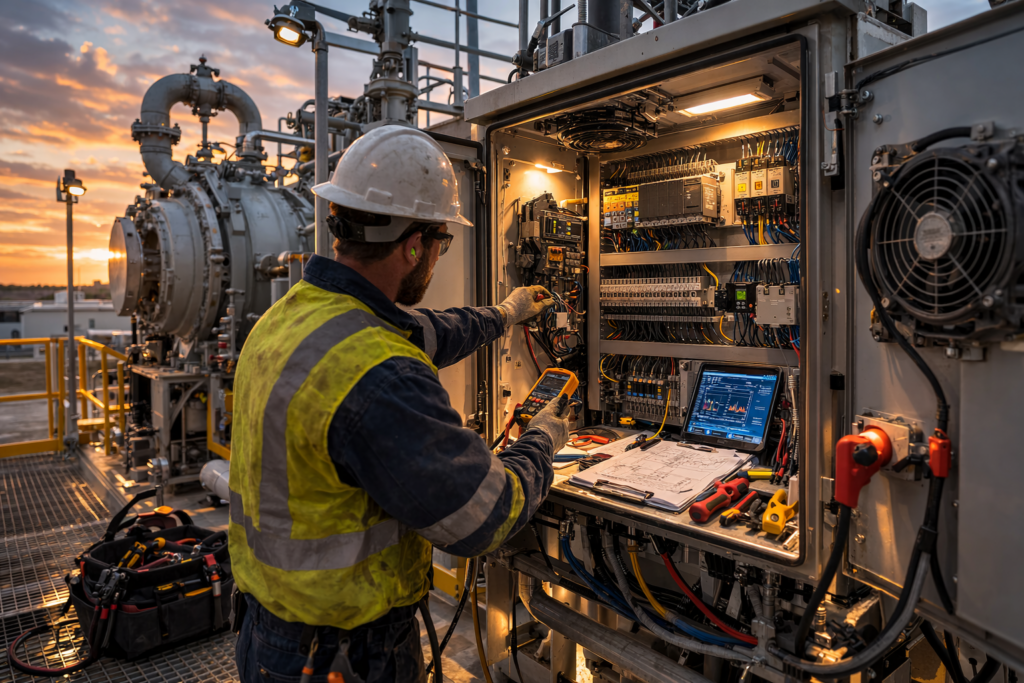
On turbine packages, control panel enclosures are often treated like a late-stage detail.
That is usually where problems begin.
In design reviews, the focus naturally goes to the turbine, piping, structure, and process equipment. While the circuits and control logics are expertly designed, the enclosure gets treated like something that just needs to be mounted and wired without consideration of the physical layout. But in the field, that enclosure often has a bigger impact than people expect. It affects reliability, troubleshooting, maintenance access, and how frustrating the package is to live with over time.
That is something field work makes clear very quickly.
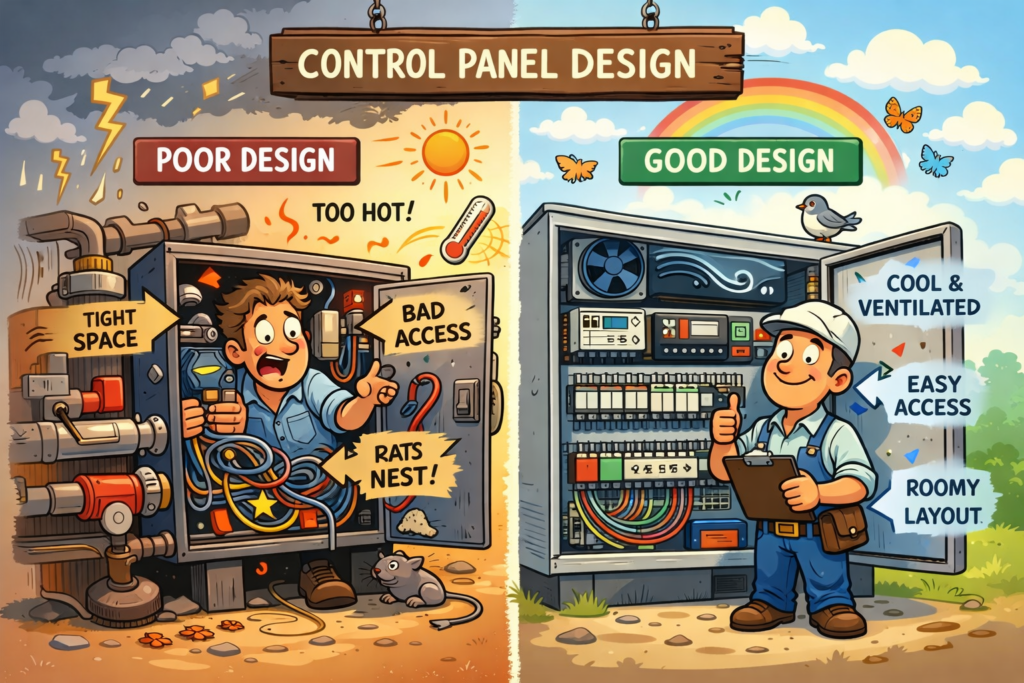
A layout may look fine on paper, but once a technician has to open a panel, trace wiring, replace a component, or troubleshoot an issue in real conditions, weak planning shows up fast. Doors do not open fully. Components are packed too tightly. Heat load was underestimated. Basic service work becomes harder than it should be.
On turbine packages and supporting equipment, better control system and enclosure design starts with better project planning.
That means thinking beyond minimum compliance. It means asking practical questions early. Is there enough room to work safely? Can critical components be reached without tearing into the panel? Has the thermal load been evaluated for actual field conditions? Will this enclosure still be workable after startup, not just during fabrication?
For EPC firms, those decisions affect coordination, layout, and long-term client satisfaction. For plant operators, they directly affect uptime, maintenance efficiency, and how quickly problems can be solved.
This applies beyond turbine packages too. The same issues show up on gas conditioning skids, combustion systems, and other field equipment. The details change, but the principle stays the same: if serviceability is ignored up front, the field will eventually expose it.
A control enclosure is not just a box. It is one of the clearest signs of whether a package was truly planned for real-world use. That is why we believe enclosure design should be approached with the people in mind who will actually operate and maintain the equipment.
In mid-market equipment builds, cost overruns rarely come from exotic materials or cutting corners. They usually come from designs that are technically sound but difficult to build. Tight tolerances where they are not needed. Too many unique parts. Drawings that leave room for interpretation. Each of these decisions adds friction inside the fabrication shop, and that friction shows up as higher cost, longer lead times, and inconsistent quality.
At Polaris Engineering Group, we approach design for manufacturability as a collaboration between the engineer, the fabricator, and the end user. When those three perspectives are aligned early, equipment becomes easier to build, easier to repeat, and easier to support long term.
Where Unnecessary Cost Often Starts
One of the most common cost drivers we see is overly tight tolerances applied across an entire design instead of where they truly matter. Precision has value, but only when it serves performance, safety, or reliability. Applying tight tolerances everywhere increases machining time, inspection effort, and rework risk without improving how the equipment actually operates.
Excessive variation is another hidden cost. When similar parts are designed slightly differently from one another, fabricators lose the ability to batch work. Every unique plate, bracket, or fastener becomes a custom task instead of a repeatable operation. That is where labor costs quietly climb.
Clear documentation plays a major role here. Even a well designed system becomes expensive if the drawings leave room for interpretation. Good drawings reduce questions, reduce assumptions, and keep production moving.
Designing With the Fabricator in Mind
We work with local fabricators whenever possible. Beyond supporting local industry, this often reduces transportation costs, especially for large skids, trailers, or assembled equipment. Shipping heavy or oversized items across long distances can quickly erase any savings gained from lower fabrication rates elsewhere.
That said, national fabricators still have a place when scale or specialization is required. The key is designing equipment that can be built efficiently in either environment. That means avoiding designs that rely on one specific shop process or tribal knowledge.
A manufacturable design should feel familiar to the shop building it. Common materials, straightforward weld details, and logical assembly sequences go a long way toward keeping costs under control.
Reducing Part Count Without Reducing Performance
One of the most effective ways to lower cost is reducing part count. Fewer parts mean fewer drawings, fewer welds, fewer fasteners, and fewer opportunities for error. We routinely look for ways to combine features or eliminate unnecessary components while maintaining strength and function.
Fastener standardization is another simple win. Using a smaller set of bolt sizes reduces purchasing complexity, speeds up assembly, and minimizes mistakes on the shop floor.
For smaller projects, we often design around bulk material thicknesses. Using consistent plate and tube sizes allows shops to buy material in volume and reduces scrap. This approach does not compromise performance when applied thoughtfully, and it often produces cleaner, more consistent builds.
When Poor Manufacturability Becomes a Bottleneck
A good example comes from a large mobile generator set we reviewed that had been designed by a previous firm. The equipment worked, but the documentation and part standardization were poor. Nearly every trailer had unique parts, which made mass production impossible.
Each unit was effectively built from scratch. Fabricators were forced to custom manufacture components on the fly, which increased labor hours, introduced variability, and slowed delivery.
Our role was to step back and rework the design with manufacturability in mind. We consolidated parts, reduced variation, and created a complete drawing package that allowed the shop to produce components in bulk. Once that happened, production stabilized, costs dropped, and the equipment became scalable.
This was not a redesign driven by performance issues. It was a redesign driven by manufacturing reality.
Blending Shop Experience With End User Needs
Polaris sits between the shop and the client. We listen to fabricators who know what works on the floor, and we listen to operators who know how equipment is actually used in the field. The final design reflects both perspectives.
That balance is what makes equipment cost effective to build, reliable to operate, and practical to maintain. Design for manufacturability is not about simplifying for the sake of simplicity. It is about removing unnecessary complexity so the important parts of the design can do their job.
Conclusion
Lowering cost in mid-market equipment builds does not require cutting corners. It requires designing with intent. When tolerances are applied thoughtfully, parts are standardized, drawings are clear, and fabrication realities are respected, equipment becomes easier to build and easier to scale.
Good manufacturable design saves money before the first piece of steel is cut. It also creates equipment that shops want to build and operators trust in the field. That is where long term value is created.
Many equipment failures look sudden, but most of them begin long before anything breaks. Stress concentrations form at small edges or weld transitions. Vibration builds in places that do not seem important at first. Flow inside a pump or pipe begins to cavitate because the geometry was not checked at the right operating point. Problems like these are common in mobile equipment and rotating packages because the loads are constantly changing. They see transport shock, start and stop cycles, thermal shifts, and operating conditions that are never as clean as the specification sheet.
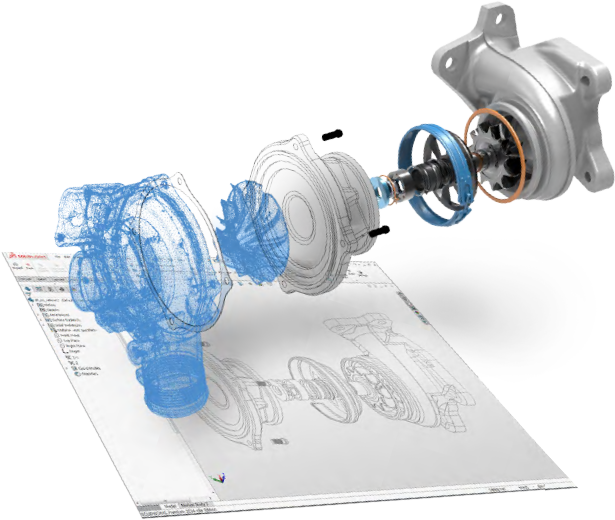
This is where simulation earns its keep. FEA and CFD give you a clear look at how equipment behaves under real conditions. You cannot see these patterns by eye and you cannot measure them during design. The payoff comes from catching issues while the equipment is still on a screen rather than on a truck or on a well site.
1. The Hidden Problems That FEA Reveals Early
In many mobile systems, the failure modes are not dramatic. They come from small details like:
sharp transitions that create stress risers
pipe runs that are too rigid and transfer vibration into pumps or motors
brackets that fatigue slowly because of repeated transport vibration
bolt groups that load unevenly
flow paths that create cavitation inside a pump housing
In harsh environments, these small issues combine until something cracks, leaks, loosens, or vibrates itself apart. Simulation is not about making a design perfect. It is about finding the weak spots before they become maintenance problems.
A good example comes from a pump skid we evaluated. The piping looked clean and correct in CAD, but FEA showed stress intensification at several points because of combined operating loads and transport loads. The solution was simple. We replaced rigid connections with flexible connectors to isolate vibration. A small design change prevented a likely failure, extended equipment life, and avoided unplanned downtime in the field.
2. Why Mobile Units and Rotating Packages Benefit the Most
Stationary systems usually see steady loads. Mobile units do not. They are lifted onto trailers, hauled across uneven roads, set down on imperfect pads, and exposed to constant vibration from nearby equipment. Rotating packages add another layer of complexity because they generate their own vibration patterns and phase relationships.
Simulation helps by revealing how these combined loads interact. For example:
a skid frame that looks stiff in CAD may twist enough during transport to change pump alignment
a pipe that seems properly supported may amplify vibration at certain frequencies
a rotating machine may load bolts or bearing housings unevenly under real operating conditions
These are not dramatic failures. They are the type of issues that raise maintenance costs slowly and shorten the life of equipment. FEA makes these interactions visible so they can be removed early in design.
3. CFD and Flow Behavior Matter More Than Most People Realize
Clients often think of CFD as a high end tool that is only necessary for large or exotic systems. In reality, a small amount of CFD can prevent serious cavitation damage or flow instability in ordinary pump and piping layouts.
CFD can show:
regions of low pressure that may cause cavitation at certain flow rates
velocity patterns that erode elbows or reducers
recirculation zones that cause pump inefficiency
turbulence that leads to vibration in thin wall pipe
A few hours of CFD analysis can save thousands of dollars in equipment repair or weeks of downtime. Cavitation can destroy pump internals quickly. Erosion can weaken a reducer until it fails. These are real costs that far outweigh the cost of a simulation.
4. The ROI Question Should Not Be a Question
One of the biggest misconceptions about FEA is that it is too expensive. The truth is that simulation is already cheap compared to the cost of downtime. Mobile units and rotating equipment packages are revenue producing assets. When they fail, everything around them slows down or stops.
The ROI becomes clear when you look at:
avoided equipment replacement
fewer field repairs
reduced maintenance time
longer equipment life
fewer emergency shutdowns
better reliability during transport
Clients sometimes believe simulation adds extra work. What it really adds is confidence. It removes the unknowns that hide inside a design. It lets the equipment operate as intended instead of reacting to surprises later.
5. Plain Language Matters Because Engineering Should Be Clear
At Polaris we explain FEA and CFD in straight language. These tools show whether a design will behave the way you expect. They help us find weak points, reduce vibration problems, and improve flow behavior. They protect your investment by making sure the equipment can handle real loads, not just ideal ones on a drawing.
The goal is to make simulation feel practical, not mysterious. When our clients understand what the analysis is showing, they make better decisions about strength, materials, geometry, and long term cost.
Conclusion
FEA and CFD are not luxury tools. They are practical methods that keep mobile units and rotating packages working longer in harsh environments. They reveal problems early when they are inexpensive to fix. They help reduce vibration, remove stress risers, improve flow behavior, and extend the life of equipment that is expected to perform in difficult conditions.
Good engineering is not only about producing a design that works. It is about creating equipment that lasts. Simulation is one of the most efficient ways to reach that goal.
Most people think FEED is where a project becomes clear and predictable. In reality, it is also the moment when small site-planning mistakes quietly take root. These early oversights often show up months later during earthwork or fabrication and they can derail a schedule that looked perfectly fine on paper.
At Polaris Engineering Group, we have learned that the most reliable projects come from treating a site as something real and active. The land has natural behavior, especially in regions like West Texas where caliche, uneven topography, and runoff patterns can change quickly. You cannot see all of this from a survey drawing or a digital model, which is why field awareness and flexibility matter so much.
Below is a practical walkthrough of the most common site-planning issues we see and how to avoid them from FEED through fabrication.
1. Misreading Natural Drainage Patterns
This is the single most common issue we catch during FEED reviews. Digital maps can show contours, but they do not always reveal how water actually behaves on the site. Natural drainage is shaped by years of erosion, local topography and even neighboring properties. A site walk often reveals things a topographic model never captured, such as:
shallow erosion paths
low areas hidden by vegetation
ponding in areas that appear flat on a map
minor grade changes caused by nearby construction
Ignoring these clues often leads to more serious issues later, such as water collecting around equipment pads, overloaded culverts or unexpected erosion around structures. Addressing drainage early is one of the easiest ways to prevent costly rework.
2. The West Texas Caliche Problem
Caliche can feel like solid rock one day and behave like an unstable base the next. Many mid-market energy projects in West Texas run into surprises when grading exposes layers of inconsistent density. Common problems include:
settlement under heavy equipment after rain
utility trenches that behave differently across the site
stormwater runoff that changes direction depending on caliche hardness
difficulty compacting pads consistently
These challenges do not mean overbuilding is the answer. A better approach is thoughtful planning. For example, we look closely at subgrade conditions, not just geotech summaries. We also pay attention to how the site behaves after moisture events. The goal is to design pads that perform well not only on paper but in the real environment.
3. What We Look for First During a Site Walk
A physical site walk provides insights that even the best maps cannot. When we walk a new site, we start by looking for three things.
1. The natural layout of the land
We try to let the topography guide the placement of equipment. High points are good for control panels, MCCs or areas that need to stay dry. Lower areas may naturally support drainage features or utility corridors.
2. How the land actually drains
You can learn a lot from soil color changes, small sediment trails or the direction water flowed after the last rain. These subtle details tell us how the site will behave once equipment and foundations are in place.
3. Small but important details that maps miss
We look for things like tire ruts, animal activity, informal pathways used by local personnel or slight grade variations. These small features often reveal how the land is used and how it may need to be adjusted once construction begins.
4. Flexibility Is Essential Because Site Conditions Always Evolve
Some firms treat FEED as a rigid roadmap. We do not. The land changes with weather, construction activity around the site and new information that comes in after initial surveys.
Because of this, Polaris focuses on flexible engineering. Adjustments are not setbacks. They are part of doing the job correctly. This mindset helps our clients avoid unnecessary stress and ensures that the design evolves as the site reveals more about itself.
5. A Real Example of How Adjacent Development Redirected Runoff
In a recent project, everything looked right during FEED. The issue only appeared once construction began. A neighboring property had been graded after our initial survey and that grading completely changed the way stormwater entered the site.
We discovered unexpected runoff flowing across what was supposed to be a controlled pad area. Erosion began forming behind some foundation locations. The site crew had to bring in extra fill, adjust pad elevations and create a new drainage path to protect buried utilities.
This was not a design error. It was a reminder that a site never exists by itself. Adjacent development and constant land changes can reshape conditions in ways that were never shown on the survey.
Conclusion: Good Site Planning Comes From Understanding the Land
Successful FEED and fabrication planning requires more than reviewing drawings. It depends on real observation, simple field experience and the willingness to adapt. When grading, drainage and access decisions reflect the true behavior of the land, the project moves forward with fewer surprises and more confidence.
For mid-market energy companies, these improvements translate into lower costs, faster schedules and better long-term reliability. Good engineering is not just about calculations. It is about understanding how the land wants to work and designing in partnership with it.
Why Modular, Pre-Integrated Design is Reshaping Modern Energy Infrastructure
Processing skids have moved far beyond “a clever way to prepackage equipment.” In mid-market energy projects—especially those balancing lean staffing, regional fabrication partners, and fast-moving capital schedules—skid-based systems have become the backbone of predictable delivery. The real value isn’t just that skids are modular; it’s that they compress dozens of interdependent phases into one coordinated engineering ecosystem.
At Polaris Engineering Group, we see firsthand that when a project shifts from stick-built to skid-based, the timeline doesn’t just shrink—it becomes far more controllable, which is often the true bottleneck in mid-market execution.
Most project delays don’t come from technical complexity—they come from coordination drag:
too many contractors on-site
field crews working around each other
late-arriving equipment
mismatched interfaces between vendors
unexpected interferences or layout conflicts
A skid eliminates dozens of those handoffs by transforming what would be a sequence of site activities into a single, off-site integrated build. Instead of trenching, welding, alignment, mechanical assembly, and electrical runs happening across a 6- to 12-week window, the skid arrives with:
piping pre-routed and supported
vessels, pumps, and exchangers aligned
electrical terminations consolidated
valves, transmitters, and junction boxes pre-tested
structural framework already load-verified via analysis
QA/QC documentation packaged on delivery
2. The Hidden Advantage: Interconnection Discipline Across Phases
The real engineering value comes from forced interconnection discipline—standardized inspection logic, unified QA/QC, shared 3D models, and FEED decisions that carry cleanly into fabrication.
A. Weld maps, NDE sequences, and inspection logic become standardized
Off-site fabrication allows for a unified QA/QC process instead of relying on multiple field inspectors working at different speeds. Every weld, every pressure boundary, and every structural component is produced under one workflow. That uniformity directly improves reliability.
B. Mechanical and electrical teams work on the same 3D model
conduit routing is built around thermal zones
pipe supports account for cable tray loading
instrumentation lines avoid vibration nodes
thermal expansion loops are coordinated with structural deflection limits
C. FEED decisions carry through cleanly into fabrication
A skid locks the FEED logic into the physical equipment:
control philosophies
process flow expectations
utility tie-ins
operational access
maintainability zones
3. Modular Skids Reduce Labor Requirements—But Also Labor Uncertainty
Skid fabrication shifts labor from unpredictable on-site work to stable shop labor:
controlled conditions
repeatable tooling setups
better NDE efficiency
lower rework rates
predictable staffing
4. Integration Planning: Where Experienced Engineers Create Real Value
Good skid engineers design to real-world tolerances, not perfect CAD surfaces. Key considerations include:
tie-in elevations
thermal load path management
vibration isolation and inter-equipment harmonics
equipment access and maintainability
5. Faster Commissioning, Fewer Surprises
A preintegrated skid allows for off-site completion of:
hydrotests
leak checks
instrument loop checks
motor rotation tests
PLC logic verification
FAT and partial SAT activities
6. The Final Advantage: Repeatability & Scalability
Once a skid solves a process challenge, it becomes a repeatable platform that can be deployed across sites, allowing companies to:
standardize operations
reduce downtime variance
simplify training
build site-to-site consistency
improve safety outcomes
reduce total lifecycle cost
Conclusion
Processing skids are not just modular equipment—they’re integrated ecosystems that compress timelines, reduce risk, and improve operational performance. For mid-market energy projects, skid-based design has become a true competitive advantage.
Engineering Considerations, Practical Challenges, and Lessons Learned from Field Deployments
Remote energy sites—whether in oil & gas, mining, industrial processing, or emergency response—depend on reliable and adaptable power sources. As operations expand into hard-to-reach environments, the demand for mobile power design, remote power skids, and portable generator packages continues to grow. These systems are not simply generators on wheels; they are engineered assets built to withstand harsh conditions, provide consistent power, and integrate seamlessly into field operations.
This article explores why mobile power solutions matter, the benefits they offer, the engineering challenges behind their design, and the jobsite realities that often require custom-built solutions.
Growing Need for Mobile Power Solutions
Mobile power solutions are essential for any operation where grid power is unavailable, unreliable, or too costly to access. Remote drilling pads, pipeline installations, construction sites, disaster-response zones, and temporary industrial setups all require flexible, standalone power systems that can be deployed quickly and safely.
Common reasons organizations rely on mobile power systems include:
Grid Independence: Critical sites often sit far beyond utility infrastructure.
Operational Continuity: Mobile generators and battery systems ensure uptime during planned or emergency shutdowns.
Temporary or Seasonal Work: Some operations do not justify permanent electrical infrastructure.
High Mobility Requirements: Power must relocate frequently as work progresses across a site.
Rapid Response: Emergency restoration teams rely heavily on pre-engineered portable generator packages.
In short, mobility provides freedom: freedom from the grid, from lengthy construction timelines, and from operational delays.
Benefits of Mobile Units
Well-designed remote power skids and mobile generator systems offer several advantages:
Rapid Deployment: Systems can be delivered, set, and energized in hours rather than weeks. Standardized interfaces (quick-connects, integrated switchgear, plug-and-play controls) reduce field labor.
Transportability: Purpose-built frames, skids, and trailers allow equipment to be moved by crane, forklift, or truck. This mobility means a single asset can serve multiple locations over its lifespan.
Flexibility and Modularity: Mobile systems can be scaled—adding fuel tanks, paralleling generators, integrating solar or battery modules, or adapting output voltages as needed.
Reduced Capital Cost: Since equipment is temporary and reusable, organizations avoid the expense of permanent infrastructure.
Improved Reliability: Mobile packages can be factory-tested and validated under controlled conditions, improving reliability once they reach the field.
Challenges of Mobile Unit Design
Engineering mobile power systems requires balancing performance with durability, safety, and ease of deployment. Several key design constraints shape these solutions:
Transportability and Structural Design
Mobile systems experience significant handling stresses—including craning, forklift impacts, tie-down forces, and road vibration. Frames and skids must be engineered for:
Road transport vibration (particularly for trailer-mounted units)
Lifting point alignment and load distribution
Wind loads on components such as fuel tanks and enclosures
Impact resistance during loading/unloading
Failing to account for these factors leads to premature fatigue, frame warping, or damaged enclosures.
Vibration Control
Generators, compressors, inverters, and electrical components generate internal vibration. When combined with road shock, the result can loosen fasteners, crack welds, or degrade sensitive electronics. Common engineering controls include:
Isolation mounts
Reinforced weldments
Structural stiffeners
Cable routing to prevent fatigue failure
Thermal Management
Remote environments often involve extreme temperatures—desert heat, frozen tundra, or humid coastal zones. Proper thermal engineering requires:
Adequate ventilation paths
Heat shielding and enclosure insulation
Optimized generator cooling airflow
Electronics rated for extended temperature ranges
Thermal mismanagement is a leading cause of derating, nuisance tripping, and component failure.
Fuel vs. Battery Integration
The shift toward hybrid systems requires balancing energy density, weight, and operational flexibility.
Fuel-Powered Systems: Advantages: high energy density, long runtime, fast refueling Challenges: emissions compliance, fuel logistics, noise, frequent maintenance
Battery-Powered or Hybrid Systems: Advantages: silent operation, improved efficiency, reduced emissions, excellent for intermittent loads Challenges: large footprint for high-capacity storage, thermal sensitivity, charging requirements
Optimizing the fuel–battery mix is an engineering decision driven by load profile, runtime requirements, and environmental constraints.
Jobsite Challenges Require Custom Solutions
Even the best pre-engineered portable generator packages often require field modifications because no two job sites are the same. Challenges encountered during real-world deployments include:
Uneven or Unprepared Terrain
Sites with mud, sand, or steep grade require modified skid bases, drag-skids, or specially designed lifting frames.
Restricted Access
Narrow corridors, congested facilities, and remote trails necessitate custom dimensions or break-down modular units.
Environmental Exposure
Hazardous locations may require:
Explosion-proof equipment (Class I, Div 2)
Corrosion-resistant coatings
Wildlife-proof or vandal-resistant enclosures
Fire suppression and spark mitigation systems
Load Variability
Industrial sites often experience unpredictable load swings. Custom solutions include:
Hybrid systems with auto-start capability
Load-sharing generator sets
Oversized alternators for motor starting
Integration with Existing Equipment
Legacy switchgear, outdated voltage standards, or unique grounding schemes may require custom electrical interfaces or engineered adapter packages.
These conditions reinforce the need for experienced engineering teams that can adapt mobile power design to the unpredictable realities of field operations.
Lessons Learned from Field Deployments
Decades of remote-site deployments have revealed several consistent truths:
Standardization reduces downtime. Using consistent connector types, control interfaces, and wiring conventions significantly speeds up mobilization.
Structural over-engineering pays dividends. Mobile units must survive the abuse of transport and field use; robust frames and reinforced enclosures improve longevity.
Interconnection and Cable management is critical. Poor routing leads to failure from vibration, abrasion, or moisture.
Hybrid systems improve fuel efficiency. Battery modules reduce generator runtime and maintenance.
Environmental controls cannot be an afterthought. Thermal issues cause more failures than any other single factor.
Clear documentation is essential. Operators rely heavily on labels, connection diagrams, and step-by-step instructions—especially in remote locations.
Conclusion
Mobile power solutions are more than temporary energy sources—they are engineered systems that enable safe, reliable, and efficient operation in environments where conventional infrastructure is not viable. By understanding the engineering considerations behind mobile power design, the challenges encountered in the field, and the benefits of flexible deployment, organizations can select or develop remote power skids and portable generator packages that meet their operational needs with confidence.
Tariffs. The mere mention of the word can send shivers down the spine of any business reliant on global supply chains. These levies on imported goods can drastically inflate costs, squeezing margins and threatening competitiveness. While many businesses scramble to react, a proactive approach, leveraging the expertise of an engineering services firm, can be the key to weathering the storm and emerging stronger.
Tariffs don’t just affect the bottom line; they ripple through the entire product lifecycle. From raw materials to finished goods, every stage is susceptible. Simply absorbing the increased cost isn’t a sustainable long-term strategy. That’s where the strategic partnership with an engineering services firm becomes invaluable.
Here’s how these firms can help mitigate the impact of tariffs:
Value Engineering and Cost Reduction:
Engineering services firms specialize in optimizing product design and manufacturing processes. They can conduct thorough value engineering analyses to identify areas where costs can be reduced without compromising quality or performance. This might involve:
Material Substitution: Exploring alternative materials that are less affected by tariffs or sourced domestically. This requires deep material science expertise and understanding of how substitutions impact the product’s overall performance.
Design Optimization: Simplifying designs, reducing material usage, or optimizing manufacturing processes to minimize waste and lower production costs. This could involve finite element analysis (FEA) to ensure structural integrity with less material.
Manufacturing Process Improvement: Identifying and implementing more efficient manufacturing techniques, such as automation or lean manufacturing principles, to reduce labor costs and improve throughput.
Reshoring and Nearshoring Strategies:
Tariffs can be a catalyst for rethinking global sourcing strategies. Engineering services firms can assist in evaluating the feasibility of reshoring or nearshoring production. They can:
Identify Potential Suppliers: Leveraging their network and expertise to identify suitable domestic or regional suppliers who can meet quality and cost requirements.
Assess Infrastructure and Logistics: Analyzing the infrastructure, logistics, and regulatory environment in potential new locations to ensure a smooth transition.
Manage the Transfer of Production: Overseeing the transfer of manufacturing processes, equipment, and technology to the new location, ensuring minimal disruption.
Product Redesign for Tariff Mitigation:
In some cases, redesigning the product itself might be the most effective way to circumvent tariffs. This could involve:
Component Localization: Redesigning the product to utilize components sourced domestically, reducing reliance on tariff-affected imports.
Modular Design: Adopting a modular design approach, allowing for the assembly of products in different regions using locally sourced components.
Product Simplification: Eliminating unnecessary features or complexity to reduce material costs and simplify manufacturing, making the product less susceptible to tariff fluctuations.
Supply Chain Diversification:
Over-reliance on a single supplier or region can make a company vulnerable to tariffs. Engineering services firms can help diversify the supply chain by:
Identifying and Qualifying New Suppliers: Expanding the supplier base to include companies in different countries or regions, reducing dependence on any single source.
Developing Alternative Sourcing Strategies: Exploring different sourcing models, such as dual sourcing or multi-sourcing, to mitigate the risk of supply disruptions due to tariffs.
Product Simplification: Eliminating unnecessary features or complexity to reduce material costs and simplify manufacturing, making the product less susceptible to tariff fluctuations.
Tariff Engineering and Classification:
Understanding the intricacies of tariff classifications and regulations is crucial. Engineering services firms can:
Ensure Accurate Tariff Classification: Properly classifying products to minimize tariff burdens and avoid penalties.
Identify Tariff Exemptions and Reductions: Leveraging their knowledge of trade agreements and regulations to identify potential tariff exemptions or reductions.
In a world increasingly impacted by trade tensions, partnering with an experienced engineering services firm is no longer a luxury, but a necessity. Their expertise in value engineering, manufacturing optimization, and supply chain management can be the difference between surviving and thriving in the face of tariffs. By taking a proactive approach, businesses can not only mitigate the negative impacts but also uncover new opportunities for growth and innovation. Don’t just react to tariffs – strategize and overcome them with the help of a trusted engineering partner.